Transcript
John: Imagine an academy that values a public knowledge commons and supports and recognizes the academic labor required to develop, maintain, build, and evolve that commons. Imagine your students actively contributing to that commons. In this episode, we discuss open pedagogy, free textbooks, and the building of such a commons.
[MUSIC]
Thanks for joining us for Tea for Teaching, an informal discussion of innovative and effective practices in teaching and learning.
Rebecca: This podcast series is hosted by John Kane, an economist…
John: …and Rebecca Mushtare, a graphic designer.
Rebecca: Together we run the Center for Excellence in Learning and Teaching at the State University of New York at Oswego.
[MUSIC]
John: Our guest today is Robin DeRosa…
Robin: That’s me.
John: …Professor of Interdisciplinary Studies and Director of the Interdisciplinary Studies Program at Plymouth State University. Robin is an editor of Hybrid Pedagogy and is a co-founder of the Open Pedagogy Notebook. She has also published on a wide variety of topics, including the Salem witch trials. Welcome, Robin.
Robin: Thank you.
Rebecca: Today our teas are…
Robin: Oh, I thought we were talking about teasing people for a second and I was like, I don’t have a tease. [LAUGHING] What am I teasing?
Robin: No, I actually have two cups of tea in front of me, which is how I like it. One is a ginger tea and one is a sunny orange because I have to stay away from the caffeine at a certain hour of the day, so I’m all herbal.
Rebecca: Sounds like a nice combination.
Robin: I know, I’m just taking one and then the other; it’s perfect.
John: And I have a Tea Forte Black Currant Tea.
Rebecca: I have a Jasmine Earl Grey, that wasn’t there before, so I gave it a try.
John: It’s been there for a year.
Rebecca: Wow, it’s been hiding under the big pile of tea that we have.
John: In exactly the same tray…
Rebecca: No…
John: I just refilled it today.
Rebecca: Oh, you know what, it was the box sitting on top that you didn’t take back after we refilled the tray.
John: Okay. [LAUGHTER]
Rebecca: That’s where I got it from.
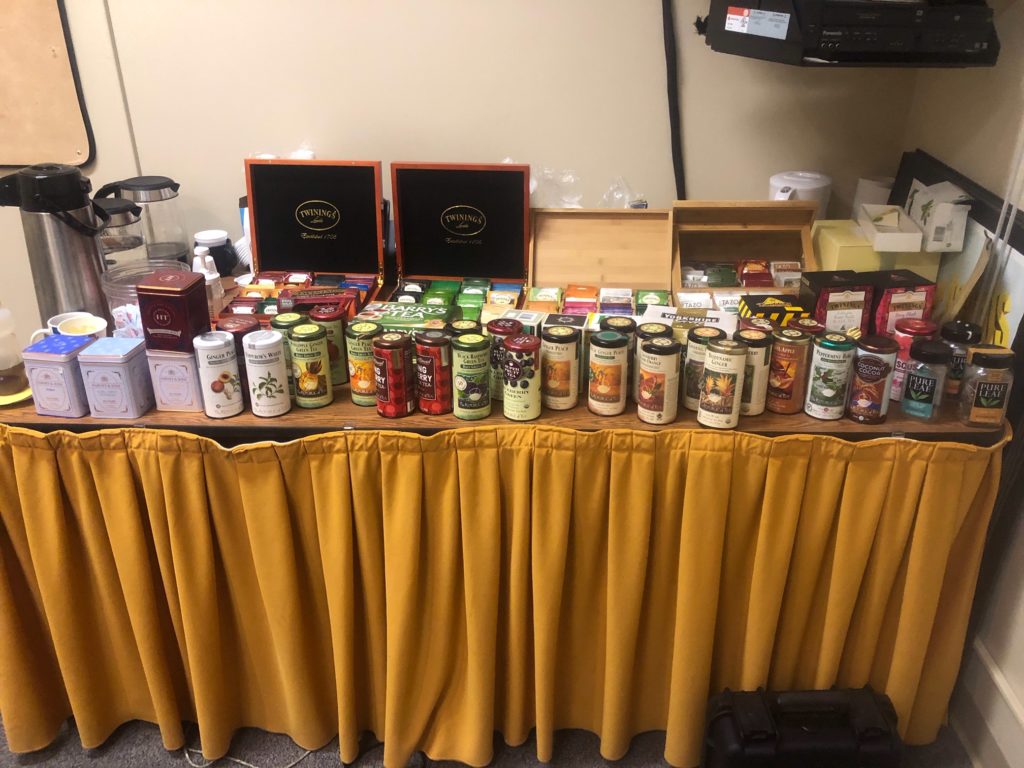
Robin: But your listeners are probably like, how could you not see a box, but if they saw this table, my jaw was on the ground; it is a really quite an impressive tea table that you’ve assembled here. You should be very proud.
Rebecca: We don’t mess around.
Robin: You do not mess around. I would use even other words but I know… public… this is some serious hardcore tea happening here. [LAUGHTER]
John: We invited you here to talk about your work with Open Pedagogy. For those that are unfamiliar, can you explain what is meant by Open Pedagogy?
Robin: Sure, which is such a funny question really because if there is a thing—and I could just say it—because there’s a lot of productive disagreement in the community about what Open Ped is; it’s one of the reasons that my colleague Rajiv Jhangiani and I started the Open Pedagogy Notebook because it’s more of a collage approach to defining Open Ped by people doing and practicing in different ways and then sharing that, but if I had to boil it down I would say it’s really about access, both to knowledge and to knowledge creation… so, the idea that we remove barriers to sharing resources and helping people access conversations and find pathways into education, but then we also try to find ways to amplify student voices to make them contributors to the Knowledge Commons and not just consumers, and I think it’s pretty salient right now as students are really in some ways maybe being pushed into these kind of training and competency models that are really about kind of downloading information and instead Open Ped suggests that we really want students to interact with knowledge and shape the world that they’re going to graduate into, not just train for it.
John: So they’re more actively engaged in the academic conversation?
Robin: That’s the idea. Right. In some ways there’s a lot of kinship, I think, with connected learning and with the idea of involving students in their academic and professional networks. Right from the beginning, because even as people who are new to our particular field, they have so much to offer and as an interdisciplinarian, we talk about that all the time that the outsider’s perspective is beneficial—it’s part of the reason you assemble an interdisciplinary team to tackle a problem and newcomers to a field ask sometimes questions that really can illuminate the challenges that a field is facing in new ways, so I have found that even the most beginning introductory students in a particular area have something to contribute both to the field itself and also in terms of helping their peers in terms of, for example, making educational materials. Students are really well positioned to make great educational materials ‘cause they understand better than anybody what’s hard to understand about a certain area.
John: They’re not subject to the curse of knowledge…
Robin: The curse of knowledge. [LAUGHTER] I have that curse, John.
John: We all do to some extent.
Robin: But it is true like when especially when I was teaching Early American Lit and you just finished your PhD and you start teaching and then you teach something for 15 years and no matter how gifted of a teacher you are, sometimes you’re like, “I don’t understand how they don’t understand this,” like “what’s hard about this?” and of course they really understand what’s hard about it, so when we did student projects where students were working on a textbook that we were crafting together, they really made some great materials for each other that I think were far better than some of the lectures I would have prepared or had prepared over the years.
John: So tell us a little bit about how you got involved in that first project you had?
Robin: I was at, ya know, one of those faculty development events that you guys might be aware of and they had brought in, ya know, a keynote speaker, and I don’t want to say I wasn’t prepared to be impressed, but it was a technology oriented conference and I was definitely one of those curmudgeons that was highly skeptical about how useful… or actually more skeptical about the ways technology was being deployed, so I was prepared to be mad, that was how I came in the room, and I actually still think that’s generally my positionality with technology is like, I’m pretty prepared to be skeptical at all times. But the keynote speaker happened to be Cable Green from Creative Commons and I had this really just pivotal “aha” moment when he was talking about the Creative Commons licenses where I realized that my students were paying 90 bucks every semester, each student, for access to public domain Early American Literature and my heart just sort of fell on the floor. It’s like why are we paying commercial publishers when all of this stuff is out of copyright. So, some students and I spent that summer before the next fall’s class rebuilding the Heath Anthology of American Literature out of public domain texts that we found online and we did not build a hearty replacement for the Heath, but we built a sufficient replacement and when we got into the class the students were super psyched that I had saved them 90 dollars, which is totally real money to my students and makes a big difference. They were grateful but they did not like the book, because it had nothing except public domain literature, so there were no introductions, no maps, no footnotes, no glossaries, no “Don’t worry, I know this doesn’t make sense to you, but let me walk you through it” kind of ancillary scaffolds. So, of course, it seems obvious now but at the time we thought we were rock star smart when we figured out like, hey, the students can make this stuff for the book, and so the students worked ahead, different pods of students would work ahead a week or two and build wrap around materials for that chapter and we got there the rest of the students would use it and, of course, it just ended up being 500 times better than the Heath Anthology of American Literature, partially because they were excited that their classmates were reading their work instead of putting it in Moodle or Canvas or Blackboard, where things go to die. So, they got excited about doing what David Wiley and others have called these non-disposable assignments and then they start getting creative, they start making little videos. Ee’d drop those in… two-minute intro to the Haitian Revolution or whatever. I put a little app in the sidebar called Hypothesis where students can annotate and so they liked that and then at the end of the semester people are like, “The best part of this class was the textbook,” which…
Rebecca: Which they made.
Robin: … they made… and they never said about the Heath anthology. So, that transformed my pedagogy partially because I was excited about making all sorts of access oriented changes in our program; we opened a food pantry at the same time as we did this, so we were thinking about lots of things in terms of accessibility of resources for students. But, in terms of thinking about not dumping my student’s work down the digital toilet every semester, it gave me stomach cramps when I first thought about what I had been doing. Every time I taught the course it was the same course, the student’s contributions weren’t transforming anything—it was no wonder that some of it felt dry to them. There was a lot of hoop jumping, and I still think I was a good teacher, that wasn’t like I was bad, but this idea of really empowering students to really, truly engage with the fields and the materials and shaping how the course runs has really changed everything for me.
Rebecca: There’s something that you’re talking about… the idea of building the textbook together, but then the course material is sort of the same from semester to semester and the materials are created by the students, so how does that continue to transform semester to semester so it doesn’t feel like it’s a one-off project… that it continues to evolve and it continues to be a value and that students continue to learn new things?
Robin: Such a great question and I get it a lot because people—I think in some ways mistakenly assume—that that first build was the exciting build, but totally that first build was the annoying build, right, because we got to do a lot of legwork tracking down these texts. We had to do a lot of copyright discovery, like “Can we use this version of Thomas Jefferson or not” and it wasn’t all that exciting, and that’s still ongoing. So Rebus community, who’s working on that textbook now, they took our version and they’re building it out; they’re still doing that kind of discovery in that initial work, and to be frank, that will never end. Even with Early American Literature you’re constantly discovering, changing excerpts, building things out, but to me what’s even more exciting is, for example, there’s a whole unit at the beginning of Native American Oral Tradition and asking critical questions about what’s the genesis of American literature. So, at the same time as I was teaching that that semester we had the Dakota Pipeline stuff happening and lots of stuff about water protectors and about native history so you can relate things to current events that way, but also think about when I finished the course, my colleague Abby Goode, who teaches Early American Literature, but very much from an environmental and sustainability perspective, she kind of remixed the whole book so that now it was about the environment in Early American Lit; they chose some different texts, they reframed the introductions. Her book, in my opinion, is quite a bit more coherent than ours was, which was more of just a collage of things. So, there’s all sorts of opportunities for how you shape and reshape, and, of course, what students are learning there, which is really the point of those survey classes in English is that there is no American literature; there is only the canon that you intentionally assemble. There’s a lot of politics and a lot of editorial choices and each semester it could look different and that’s an important lesson because the Heath anthology was not a neutral objective collection either and I think that’s been a helpful way for them to encounter the building of canon.
Rebecca: I think it’s really easy for people to imagine how this works in the humanities. Can you provide some examples or ways of thinking about being open in the same way in STEM or in business or other disciplines that might not latch on quite as quickly?
Robin: Yeah, and my colleague at Keene State, which is one of our sister institutions, Karen Cangialosi, published a wonderful article recently called “You Can’t Do That in a STEM Class,” which is basically the answer to your questions. We should just stop answering questions and you should go read that article now. But really, the open dcience movement is a huge movement, in some ways dwarfs open education and I think climate change is a really good example of this, but also just open access publishing, the idea that in order to have scientific breakthroughs we need to have the public sharing of scientific knowledge and collaboration in science and so bringing our students into that early as opposed to saying, “Here when you’re a student you’ll be confined to this one class and stuck in this one book, but then when you become a scientist we assume you’ll just understand how to become part of this larger, more public scientific community.” That makes really little sense. So, what you’ll see in classes by people who work this way in STEM, and Karen’s a good example, is that their students are working on issues that are of critical importance and they’re putting their research and ideas into the commons and asking mentor scientists to engage with them. So, we understand that our students are not always going to be doing top-level research; the next breakthrough in diabetes research is not necessarily gonna come from a sophomore. Although occasionally you hear those stories, right, but really what they’re gonna do is they’re gonna ask for guidance, they’re gonna ask for help, they’re going to amplify other scientists’ work and translate them for their communities so that a new generation of scientists can get access to the issues and that’s how we’re going to assure that our scientists are working for what I might call the public goods. So, we’re seeing lots of people using blogs for this purpose instead of just doing their labs in a vacuum or whatever, sharing some of that work and creating sites together, or working in experiential ways through internships. This is why I sometimes bristle about OER being kind of like a cheap or free textbook movement. It’s really very much about a public knowledge commons and how we bring students authentically into that, so when my students are out in the field… and I teach interdisciplinary studies now, so my students are pretty much not in the humanities, to be honest. I have lots of business students, lots of students working in marketing, lots of students in allied health, physical therapy; they’re all in my program, and the work that they do in our open textbook and with OERs is one thing and we do create all of our own materials for the program, but beyond that they’re also creating capstone projects that are generally online, often openly licensed; of course they hold the autonomy to make those decisions for themselves. At that point they’re pretty educated about how open they want to be and then they’re also working on applied projects out in their fields and I see all that stuff as part of the same way that we engage our students in the public world of knowledge.
John: And science is often taught, or at least it’s perceived by students, as this body of knowledge they have to memorize rather than this ongoing dialogue and a series of active research projects, and when they are more engaged in the process of making those connections it’s likely they’ll learn it better and they’re likely to become much more interested in the subject, because one of the main problems in the STEM fields is that students give up early on. But if they can see the relevance, I would think they’d be much more likely to continue onward.
Robin: Yeah, I think it’s a great point. I’m also the mom of a teenager right now who—is this gonna make my whole family sound bizarre? I’m not sure… but she’s got an obsession with taxidermy, so if you go into her room it’s all—I’m not joking; we’ve got boars, we’ve got bison, we’ve got deer, we’ve got every pelt you could imagine, and then her bookshelves are filled with skulls and bones…loves it. She’s out there digging for bones from the time she was little, researching which skull is this, what skull is that; she doesn’t like science, though; that’s what she tells me: she doesn’t like science. I’m like, you do like science, you nutty kid.
John: You’re kind of doing it; this is where a lot of science started.
Robin: That’s right, and so I’ve been waiting for her and she’s had great teachers here and there, but she really did finally have a biology teacher last year who helped her understand that she does love science, but before that she thought, I don’t really like these worksheets and I don’t really like memorizing these tables, and she’s an interactive person. So, I think there’s a lot of compatibility between open and active learning and experiential learning and high-impact practice and all these buzzwords. People call me an advocate for open, which I am, but really I’m an advocate for learners, like paying attention to the kinds of things they are constantly telling us that they need in order to be successful. While we’re over here shopping for some kind of software program, they’re sitting right here telling us, I’m hungry or I can’t afford my materials or I don’t feel like my voice matters or I don’t know enough to be useful here, so you just tell me what I need to know.
Rebecca: Or I’m not represented.
Robin: I’m not represented. That’s a huge one because when you transfer to this mode of learning, it’s a little bit the sort of Wikipedia model, although Wikipedia is a horrible example because of representation in Wikipedia and the stats we have on that, but the idea that you can pay attention to all the voices in your community but the open movement is really wrestling with this right now to figure out how much is about open and licenses and sharing and how much is about creating an ecosystem of inclusivity, access… the kinds of things that truly do shape a commons, which we mostly don’t have in education, so the commitment, I think, is for me is less to the technicalities of open and more towards the long-game vision, which is really about how do we bring more voices to the table to engage in the community for whatever the community’s needs are.
John: I wanted to go back to a point you made earlier; it reminded me a little bit about some behavioral economic studies and I haven’t thought about this before, but I think it’s relevant. There was some interesting experiments done by Dan Ariely a while back. Dan Ariely calls this the IKEA Effect and he notes that when Duncan Hines first started selling cake mix they sold horribly and the reason was you just added water, you stirred and you baked and people didn’t feel that they had created something, so they changed the mix so you had to add an egg to it and stirred and mixed in and baked it, but by the simple act of breaking an egg and mixing it in, it felt like they had created something in a way it wasn’t where they just added water. One of the experiments he did was he had people create these origami by following directions… of paper cranes and he asked them to evaluate how much they thought their creations were worth and then he swapped them and he asked them to evaluate someone else’s creation and people valued their own at roughly twice as high as the others across the board, and then he changed it in another iteration of this and he took some of the directions out… so it was really hard to replicate and objectively, when people evaluated the other people’s that time they rated the value of them much lower in terms of how much they were willing to pay, but because they put more work into building these things themselves, they rated their own creations much higher, and the simple act of creating something gives you this feeling of ownership and value that I think would be a useful part of this in terms of getting students much more engaged with the process and more engaged with their own learning.
Robin: Yeah, so I would say two things about that super fascinating set of stories that I’m totally going to use all the time, maybe tomorrow, when I speak with your faculty. So the first is that we run a customized major program where students create their own majors and the cake mix effect is enormous in our program; we have almost a hundred percent retention in our program, which I think is so very much attached to this idea that if you create it yourself that sense of ownership is huge. So, the one way I would revise your stories is the Duncan Hines model is kind of a slight of hand, right, you know, we could of just put the egg in there, and so that’s the part that I’m always wrestling with is this no hoops and mean it, so it’s actually kind of a big leap because in education we’ve known for a long time that we want to build student ownership, but we do a lot of tricks to kind of say, doesn’t this look like ownership, so how do we authentically do that instead of just sort of fake removing the egg and that’s where I think you see a lot of institutions push back—they are happy to make their students feel empowered, but they are not happy to empower their students.
John: That’s scary.
Robin: Yeah, it’s very scary and we talked about student-centered learning; when I started doing student-centered learning I was like, “Chumps, you are not doing no student-centered learning because once you center your students the whole course changes, falls apart a little bit.” It’s also the magic of tenure; it’s very risky to do a lot of the things that I’ve been blessed enough to be able to experiment with it, which have paid off, I think, hugely for our students, but there’s a lot of pushback sometimes from students and oftentimes just from institutional structures that can’t really accommodate learning that looks like this very easily, so that egg is kind of the whole thing there, right, and I love your metaphors; I’m gonna borrow them.
Rebecca: When you want to be authentic that also means that you have to be ready to completely change any plans; it’s like, oh, now we’re going down this rabbit hole that I didn’t know we were gonna go down, but I guess we’re going there and we’re all gonna go together and be open to that.
Robin: Some people are like wired for that, like my husband is a sculptor and that’s kind of the studio ethos, but so not how I came to teaching. I mean, I didn’t have my lectures written out but just super organized and when I would come to an epiphany it was always an epiphany that I had planned for many weeks… I think, “Oh my gosh, this reminds me of this thing, can you believe it?” And of course I knew all along that we were gonna be arriving at that epiphany, so when students would move in a different direction, even if I could tell at the time it was brilliant, you would have to pull them back to the place that you were going, but I have definitely changed my mode of operation because the content, really whatever you teach, it doesn’t exist in the world in 14-week packages, so the idea that you can’t do such-and-such because you’re going to miss this key fundamental thing is just bizarre when you think of the scope of knowledge, so I understand people wrestle with accreditation and we wrestle with standards and all these things are realities. But, for the most part, I think really radically meaning a lot of those buzzwords that we use is revolutionary. If you read your mission statement for your university and then you actually do some of that stuff, it’s gonna be crazy; nobody’s actually doing the things they say that they do, in my opinion.
Rebecca: A couple of weeks ago we had an episode about metaliteracy, which expands the idea of information literacy to include the idea of creation, so the idea of becoming more literate in the making of things as part of that information literacy process, which is clearly very connected to the idea of being open, especially when your students are creating this content and creating knowledge. The question that I have is one that I’m wrestling with currently as an educator who’s really about access as well, but I’ve been focusing a lot on access for people with disabilities in thinking about accessibility in that way, digital accessibility and learning those skill sets and where those come in and how do we make sure that things are visually organized and consistent so that an experience through these things that students are making is a good one for everyone who comes afterwards as well?
Robin: I am so happy that you asked that question because this has been my last three weeks; I have barely slept because I’ve started getting so excited. So, for probably the last year or so my own personal challenge has been to think about accessibility in terms of making our materials more accessible, so I’ve been learning about how screen readers actually work in order to fix my own syllabus to redo a lot of annoying things because I didn’t realize you had to use the headings to make things easier. So, I’ve just been learning that basic stuff and that’s been just a long, slow and interesting process. One of the last things that I really hadn’t learned about at all or hadn’t even really thought about was in giving presentations, which I give a lot, I had to think about slides… and so at Open Ed ‘18 in Niagara Falls… I wasn’t there, which is actually an important part of the story because one of the keynoters was Jess Mitchell, who is kind of a mentor of mine in terms of accessibility stuff—she’d be a great guest—and Jess gave a really moving and powerful keynote focusing mostly on inclusion in open and she is very much an accessibility advocate and what was amazing to me as someone who was not there and didn’t see a recording was when I looked at her slides afterwards I was able to experience really the whole keynote because they were designed to be accessible to folks who were in the room, text was organized in a certain ways and things were very clear and I came away really grateful for how she had set up these slides, which was interesting because they were really different than the kinds of slides I make. I had always prided myself on like “Robin made some fancy slides,” you know, they’re like just pretty and like visual impact and bold images, but because they were, I think, graphically designed in a lovely way, I mistakenly thought that that meant that they were actually accessible because they were clear in certain kinds of ways, but they weren’t, they weren’t set up well, so what happened was when I learned and saw in action some of the techniques that she was using, I started to look at this keynote that I was giving the other day—I had like two days left—and now the keynote was ready to go, all the slides were made; I looked at the slides and I was like, oh, crap, you know, no… So, I thought I’ll just redo these slides real quick, but what I ended up doing was really learning about the accessibility changed everything about how I approached the making, which actually ended up changing all of the ideas in the keynote in this dramatically productive way. So accessibility for me, of course, is not really just about like, oh, you have low vision or whatever; it’s very much part of this access broadly-writ idea… that openness… But beyond that because it’s built into how we build; it’s really about how we’re gonna design infrastructure and that is actually my passion right now; it’s less about making these materials—okay, so great, here’s an accessible material, great, they should be—but beyond that it’s about let’s just design an ecosystem now with access at the heart. So, in terms of accessibility, none of that sort of retrofitting one-by-one whatever, but also just what would happen with everything if access for the broadest array of learners was key. I was recently in Providence, Rhode Island at College Unbound, which is just a very cool program for adult learners completing college—they have to have least nine credits to start—but many of them have many more… and there are mostly students of color, mostly poorer students and mostly, I’d say, they seem like over 30 in age and they start their seminars with a hot meal and then after the hot meal they go into their different cohorted seminar rooms and tons of those students have their kids with them and the kids are just a normal part of the learning environment there and the whole place is designed around what kinds of access people needed, what times of day and what services in order to come here to learn and I just feel like everything about the content that we’ll produce and the ways we’ll set up schools and just everything will change if that’s how we build—we build around what I might call human beings, right, which is like the most innovative idea of all, right, it was not technology, it was humans.
John: Audience matters, as Rebecca is fond of mentioning on this podcast.
Rebecca: I almost did it earlier but I…
John: Well, I did it for you this time.
Rebecca: …I contained myself. [LAUGHTER]
John: But, It is important.
Robin: And it’s exciting, I mean, honestly, it’s just exciting because you do realize when you start thinking this way that it is again gonna change everything, right, you’re not just gonna put a caption on your video, it’s gonna be like every single thing is gonna change and that’s why it’s also important to say like, “Here’s how I still suck,” because you can’t just decide to do this and then be done. I’m just learning every single day, I’m messing up every single day and I think it’s better to kind of own that and think of it as a process, which is really invigorating.
Rebecca: To speaking about the process, how would someone get started? What advice would you give someone who is inspired to be more open in their process and the way that they teach and what they put out in the world? What’s the first step?
Robin: Well, the first thing I might encourage people to think about is what excites or interests you here? I think starting with a thing is not really the way to start. So, for example, a lot of times people will come down into our teaching and learning center (where my office is co-located—in the teaching and learning center). So, people will come down—“I need to start a blog with my students”—“Oh, okay, we can help you with that, why do you want to do a blog? “I don’t know; everybody’s blogging.” “Okay, we got to blog.” You really don’t have to blog; you could blog, we could help you, but I think having a sense of the goal: do you want to connect your students out to their communities? Do you feel like that would be valuable for your students? Would you like to lower some access barriers for your students? For me, there’s a lot of excitement that happens when I think about the hardships that we face in public education and trying to make a case for working in more public ways and what public work looks like, so I tried to start with what might excite faculty. So, you can do that on a one-on-one level or when I talk to large groups of faculty I usually start by helping them understand some of the implications of the high cost of textbooks, so if you just say to a faculty member, “That textbook costs a lot,” it’s too abstract. Usually they’ll just say, okay, this was 200 dollars and this one is $180; I’ve picked the 180 dollar textbook, I’m a good person… and they are… but showing them some of the data on what happens to students who can’t afford textbooks, and we have that data collected now and you can reach out to your librarians to access that data really quickly, talking about that with faculty and helping them see this as a social justice issue that impacts whether their students will pass classes, take credits, graduate from college, that I have found is persuasive, but then also talking about engaging their students in the world, really helping them to contribute rather than just consume, become better critical thinkers, all of those things are persuasive. Saying faculty don’t care about cost… I think first of all is not super true, but it’s also like we’re told all the time as faculty, cut costs. Cutting costs does not do wonderful things for learning most of the time. The things we’re asked to cut, especially in our public institutions right now. The age of austerity is decimating to innovation, in my opinion.
John: And the cost of textbooks has been rising at three to four times the rate of inflation for the last several decades?
Robin: Yeah, If you graph it out, I think the thing that I found most shocking was there’s the Consumer Price Index, you know, down below and then there’s the spiky line of the textbook cost and then if you map healthcare—it’s actually in between—it hasn’t been rising as fast as textbook costs, so I think people sometimes find that alarming.
John: Shocking, because that was also rising much faster than the inflation rate.
Robin: Exactly.
John: Going back to the issue of access, the students who have the most trouble affording textbooks often come from households where the parents have less education. Because there’s less early human capital development in those households, those students are already often starting at a bit of a disadvantage and many of them will choose either not to buy the book or wait as long as they can before buying the book. So, they’re far behind when they’re starting their classes and that would be a major factor in their retention on campus.
Robin: Yeah, actually some of this data that you’re talking about comes from the Florida Textbook Study in 2016, which is very persuasive for faculty, I think, but there’s some really new data—Eddie Watson out of Georgia, I believe, that just came out that shows that the benefits of switching to OER in terms of things like course throughput rates, grades and passing and…
John: the drop, fail, withdrawal rate, yeah.
Robin: …that the benefits are especially pronounced for students of color and for Pell eligible students. Some of our most vulnerable learners stand to make the biggest gains when they have access right from day one, and faculty recognize this when you talk to them about it because they are very used to having the small number of students in this side of the room saying, “My check isn’t in yet; I need to wait two weeks until I get paid,” or “I ordered a cheaper version that’s gonna be here in six to eight weeks” or whatever, so nobody’s surprised by it, but to realize that you are actually empowered to solve a problem in higher education is surprising to people and OER actually solves a pretty concrete problem and pretty quickly and the data shows us it solves it pretty well.
Rebecca: So what you’re saying is that OER is the gateway to open pedagogy?
Robin: Well, it’s so funny… [LAUGHTER] I have actually become maybe more famous in the community for saying the opposite because that is actually the party line: catch them with the OER and then show them the pedagogy, but as you’ll see in the faculty development talk that I’ll do here at SUNY Oswego tomorrow, I do that a little bit but definitely I think people are kinda like, “Okay, I’m in, yeah, sure,” and then you start talking about the teaching and learning and that’s when people really kind of come alive and then they shrink back again because they say, “Well, that’s you, because you’re techie and you’ve been doing this forever” because it looks overwhelming and I just want to tell them, first of all, I’m an early Americanist; there is nobody less oriented to this work than I was when I started, but I only heard about Creative Commons maybe like four years ago, like that was the first time I heard of it and now every single thing I do is related to this stuff. The learning curve is overwhelming at the very, very beginning, but the tools that you use and the ability to make these kinds of changes, especially if you do them incrementally. It is really within anybody’s ability and people should trust me when I say that because my husband is a sculptor—he’s a studio sculptor, teaches welding and that kind of stuff and he’s doing all of this now. So, he does OER, but he’s also doing lots of connected learning and his students have their own domains and he is somebody who for the most part does not really even enjoy email, so anybody can engage and I think we need good librarians and good instructional designers and we need to keep funding teaching and learning centers because paying big money to fancy software programs and outside contractors, these are sort of Hail Mary passes to save education. But, in my opinion, teaching and learning and instruction shows real benefits, but we don’t invest in it and we therefore can’t expect to get the full rewards that we could get if we were really focused on working with our faculty.
John: And a lot of the really powerful tools used in these courses are free, like Hypothesis, as you mentioned before. Do you recommend, for example, the use of Pressbooks for OER materials?
Robin: Yes, I’ve been very inspired by the Critical Digital Pedagogy folks out of Hybrid Ped and one of the things they talk about is analyzing your tools and I’ve been really trying, along with my work in accessibility—the other kind of learning curve for me right now has been trying to go through my own tools and gravitate towards not just free but open tools and that’s challenging in some ways; in other ways we’re all ready to go. I favor nonprofit companies like Hypothesis and Pressbooks is Open-source software; I use it through Rebus Community, which is a non-profit OER publishing community that’s developing now under the direction of Hugh McGuire, who was previously with Pressbooks and developed Pressbooks. So, I think the tools should not stress anybody out because the tools will be different next week, right? So, it’s not worth getting too worried if you’re like, this tool it makes no sense, okay, well wait till next week; they’ll be another tool, but it’s good to ask critical questions about if we’re really trying to not just save some cash but to maybe transform into more of a learning ecosystem that focuses on the public good, then we need to build infrastructure that has similar commitments to the kinds of content we might look at or the kinds of processes we might use in our pedagogy. That’s my goal now, is to transfer whatever I’m using into tools that have the same sort of investments that I do.
Rebecca: Speaking of infrastructure… We have infrastructure for students in teaching and learning the classroom kind of side of things, but we also need infrastructure to support faculty who want to be open and do open publishing and do this public good or public discourse methods in general. So what recommendations do you have for helping us move in that direction for public scholarship?
Robin: Yeah, but there’s a lot of myth-busting that needs to happen around open access publishing. Mostly faculty do have some pretty good autonomy, so the promotion and tenure processes that faculty will tell you, “I can’t publish in this journal because it doesn’t meet the impact factor regulations for my field.” Well, those are mostly coming from, like that old joke, “It’s coming from inside the house,” right? Really what this is is about faculty education to help faculty understand that it’s not in the best interest of faculty or knowledge to have the commercial publishing industry stranglehold on academic publishing, but of course faculty are concerned that there are quality issues, they think open access publishing sometimes is like, “I self-published this on Amazon” or whatever, so helping them understand that there are definitely low quality, predatory open access presses just like there are low quality, predatory commercial presses and helping people understand that what you’re really talking about is not whether it’s open or closed but what’s the peer review and what are you looking for in peer review. I think we’re seeing lots of institutions move towards open access policies that give faculty lots of autonomy in how they control their materials, but we need to do a better job educating ourselves about what’s wrong and broken in academic publishing right now.
John: SUNY has just introduced an open-access policy for the whole SUNY system very recently, and (at least at our institution) the upper administration, including the President, the Provost, and the Deans, have generally been very supportive, but it doesn’t always make it down to the departmental chairs and personnel committees and that’s a barrier that, as you said, we’re imposing on ourselves and it’s tough to get through, especially if you’re a junior faculty member coming up for tenure.
Robin: That’s right, and usually I tell administrators that I work with, it’s great that you’re supportive; please don’t tell anyone, you know, because we don’t want these to be top-down initiatives, they have to grow from the faculty and I don’t mean that again in the kind of Duncan Hines egg sense—like a fake way; it’s important that faculty steward the new era of academic publishing—that matters; that should not come from administration, should not come from state legislators. The state legislators are only too excited really to say, everyone must use OER. I went to our board of trustees and they were really happy to give us money for open and they said, we’re gonna pass a resolution that everybody needs to consider an open textbook—I said, thank you, I don’t want your resolution; I’m very grateful… Because it really is important that we do the education at the source which really is for the most part with faculty and actually with students, I think, is where it matters and we’ll grow it that way and the reason I have hope is that I’ve never talked with anyone for any length of time and had them say at the end, well that’s horrible and stupid. There’s lots of nitty-gritty problems to iron out and the open access community does not yet know exactly what the best path is for funding open access presses or all sorts of issues, but it’s very hard to find someone to say to you what you’re saying is horrible, so I think that we will see huge transformation in both OER and open access publishing in the next five to ten years, but we need to grow it with our people.
John: And some of the STEM fields have led the way there; the National Institute of Health and all their grants require
Robin: NASA, the White House….
John: …that things be publicly available and in public access.
Robin: Yeah, and of course those publishing models are a little bit different because there’s so much grant funding in science and the public has a right and that might be a little bit different than, say, a monograph by a historian. When we talk about open we always want to talk contextually, I think, and specifically about what makes sense for, I think, two groups: the public and the knowledge—thinking about both knowledge and users for every different example.
John: Where do you see open pedagogy as going in the future? It’s a relatively recent area and you’ve been very actively involved in this, but where do you see things going in terms of new and interesting directions?
Robin: I cannot answer that question because it boggles my mind… the question you’ve asked and I don’t think I can answer it and it wouldn’t help me to go away and think about it. I think what I could answer is where I hope things are going, and I feel very strongly that there needs to be a robust connection between open education and public education, and I feel like we are in a very dark time where our public education channels are being insidiously co-opted for private profits, and even in some of our public institutions you’re seeing the language of public just dissolve, so we’re seeing college presidents saying, “Yeah, that’s over, that era is over; we’re not going to get any more public dollars; it’s dried up; we need to get corporate money, we need to do partnerships, we’re gonna fund ourselves in these new private ways.” I think this is our chance to intercede in what I see is a very downward trend and I think open education has some really incredible possibilities for helping us articulate what public practice looks like and if we can articulate what public practice looks like, the fact of the matter is, and I do not think this is an argument, I think it’s a fact;—it’s true—I really think it’s true that it is in the public’s benefit for the public to fund the kinds of public work that we’re talking about here for both students and researchers and if we could help explain why by being a little more coherent for ourselves with what it means to work in and at public education and research, I think we’d have a better chance at making that case for the public. So that’s where I’m hoping to take all of this is to say really what we’re talking about here is a resurgence for public education at the K-12 level, resistance to the charter takeover and higher ed to say it’s time to reclaim a public mission for our public universities and fund them appropriately and realize that innovation comes from people and not from private, gated… Right now, the idea is that all things innovative thrive in the market and I think that’s because we’ve been intentionally starving and strangling our publics. Wow, that was like really radical.
Rebecca: That was good, yeah.
John: And it’s an important message.
Robin: I think it’s coherent and I think it’s persuasive; I feel people come alive when I talk about it, but we need also some national leadership on this both from inside education and inside government and I don’t just mean nationally,—the United States is in a squalid mess right now, which it is—but just even in the Obama years and whatever like who are our champions for public, where is that coming from? I’d like to see more mentors and like to see our college presidents use this kind of language—if you’d like to hire me to be your college president… [LAUGHTER] Call me. [LAUGHTER]
Rebecca: Maybe that’s a “what’s next.” [LAUGHTER]
John: So, we usually end these podcasts by asking, what are you doing next?
Robin: Tomorrow, I will be here at SUNY Oswego. You know, the question of next is a really hard one; My own personal life has been changed so radically by this. I never saw myself leaving the English department, I never saw myself having a whole in some ways second career. I used to be asked to be department chair because it was your turn, not because I was anything special, and I would go under the table, you can’t make me do it. I declined everything. I really think, though, people with a grassroots passion for doing this work need support at higher levels in higher education. In terms of me personally, I started thinking about trying to step into some of those roles and I can’t say I feel sort of super personally excited about some of the aspects of that work, but I know that even though I see this as a grassroots movement,—and I do use that word—it’s really hard to change institutions, and in order to do it we’re gonna need to get people at every level to care about these kinds of things and so I’m inspired by people like Tressie McMillan Cottom and Sara Goldrick-Rab and they’re faculty, but they step out to set a national example, and I’d like to maybe think about trying to move this stuff a little bit more institutionally, as opposed to just inside of programs or with particular faculty development events. I’d like to see some institutions really step out and lead. SUNY is doing a great job. You guys have about 48 of your 64 institutions, I think, actively engaged and you are careening towards some system-wide impacts, partnerships with CUNY, statewide conversations; this is where I think things really get exciting to me.
John: The community college and SUNY have really been leading and they’ve been very active in doing this. The four-year colleges have been moving, but not quite as quickly and the university centers have a bit more inertia. So, SUNY has been making some really great efforts in providing incentives and doing a lot of encouragement and the workshops they’ve been funding have helped to try to get more grassroots movement, but it’s not as quick as many of us would like, but it’s much faster than it was a few years ago.
Rebecca: Incremental change is still change?
John: It is.
Robin: It absolutely is. Someone was telling me… Is this an economics thing about the parable of the ant, that ants are going up a hill? Okay, somebody on Twitter, you just sent me this,—I’m losing my brain now—but anyway, an ant is going up a hill and when because of the position of the ants eyes they can’t assess the whole hill, so all they do is at every point they could assess, I want to get to the top of the hill, and all they can assess is, okay, this is the next step that I take, so then the ant gets to the next step and it assesses again and that’s the kind of way incrementally the ant will get up. In that sense the ant doesn’t really even have to know where it’s going; it is just able to constantly resurvey and take one more step and I found that really reassuring when someone sent that over to me today. That’s kind of a metaphor for how you can keep going when you don’t always know exactly where you’re going, and also to your other point, community colleges are clearly the national leaders in this work and I find that really good for education because community colleges are actually really good at teaching and learning and it’s important to look at what they’re doing with open to learn our lessons, but also we can just learn a lot from partnering with our community colleges more effectively.
John: And they’re often the first point of access for first-generation students who may find it difficult to go directly into a four-year college, and they have many of the students who most need that sort of access.
Rebecca: Well, thank you so much for spending time with us and engaging us in this really great conversation; I hope that incremental change becomes much bigger increments as we hear more people and more people get on board.
John: And if you get one person in department doing it, it’s a whole lot easier to convince others to try.
Robin: There’s no secret trick or no secret sauce, it’s just people, so every time somebody as a human gets invested you actually get a lot closer to where you’re going, I think. It’s exciting, it’s exciting, and thank you guys for having me because this like fancy stuff and I feel very listened to and I’m gonna put all sorts of pictures on Twitter of myself in front of these microphones. [LAUGHTER]
John: Okay, well thank you.
Rebecca: Yeah, thank you.
[MUSIC]
John: If you’ve enjoyed this podcast please subscribe and leave review on iTunes or your favorite podcast service. To continue the conversation join us on our Tea for Teaching Facebook page.
Rebecca: You can find show notes transcripts and other materials on teaforteaching.com. Music by Michael Gary Brewer.
John: Editing assistance provided by Kim Fischer, Brittany Jones, Gabriella Perez, Joseph Santarelli-Hansen, and Dante Perez.
[MUSIC]